🖼️Goodrich Castle | A Castle Was Also a Home
Goodrich Castle | A Castle Was Also a Home
When we look at a medieval castle, it is easy to imagine soldiers, battles and heavy stone walls.
But Goodrich Castle had another side.
Behind these walls lived a large and surprisingly busy household — people who cooked, cleaned, prayed, worked with horses, kept accounts, served meals and looked after the needs of the family who owned the castle.
For much of its history, Goodrich was not simply a fortress.
It was a home.
Hundreds of People Behind the Walls
During the late 13th century, when Goodrich belonged to Joan de Valence, the castle could accommodate a household of sometimes hundreds of people.
The surviving accounts of Joan's household give us an unusually detailed glimpse into medieval life.
There was a baker named John, a chaplain named Giles of Barynton, a chapel clerk called Ralph Bluet, a coachman named Hamo and a farrier named Walter.
These were not anonymous figures in a history book.
They were people with specific jobs, responsibilities and lives inside the castle.
An Extraordinary Amount of Food
One of the most fascinating details is simply the amount of food required to keep such a household running.
When Joan de Valence arrived at Goodrich in November 1296, 81 pigs were slaughtered in preparation for her stay.
Bread was baked every day, with better-quality flour used for the household's most important members.
Meals were also very different from our idea of a quick lunch.
There were normally two main meals a day, and together they could occupy up to six hours.
Eating was not simply about satisfying hunger. It was also a social ritual, with seating arrangements carefully reflecting the status of everyone at the table.
Look Beyond the Walls
That changes the way I see this photograph.
The stairs, doorways and rooms are no longer just architectural fragments.
They were part of a functioning environment.
Someone walked up those steps.
Someone worked in those rooms.
Someone waited behind one of those doorways.
Someone probably stood here centuries ago without ever imagining that one day these walls would become a ruin visited by photographers.
That is one of the strange pleasures of photographing historic places: the stones remain, but the ordinary lives that once filled them have almost completely disappeared.
📷 Photo Notes
Location: Goodrich, Herefordshire, England
Site: Goodrich Castle
Period represented: Medieval / mainly late 13th-century architecture
Subject: Interior courtyard and surviving domestic structures
Photographic approach: Architectural detail and atmosphere
Series: Goodrich Castle, Wye Valley
“A castle becomes truly human when we remember the people who once filled its rooms.”
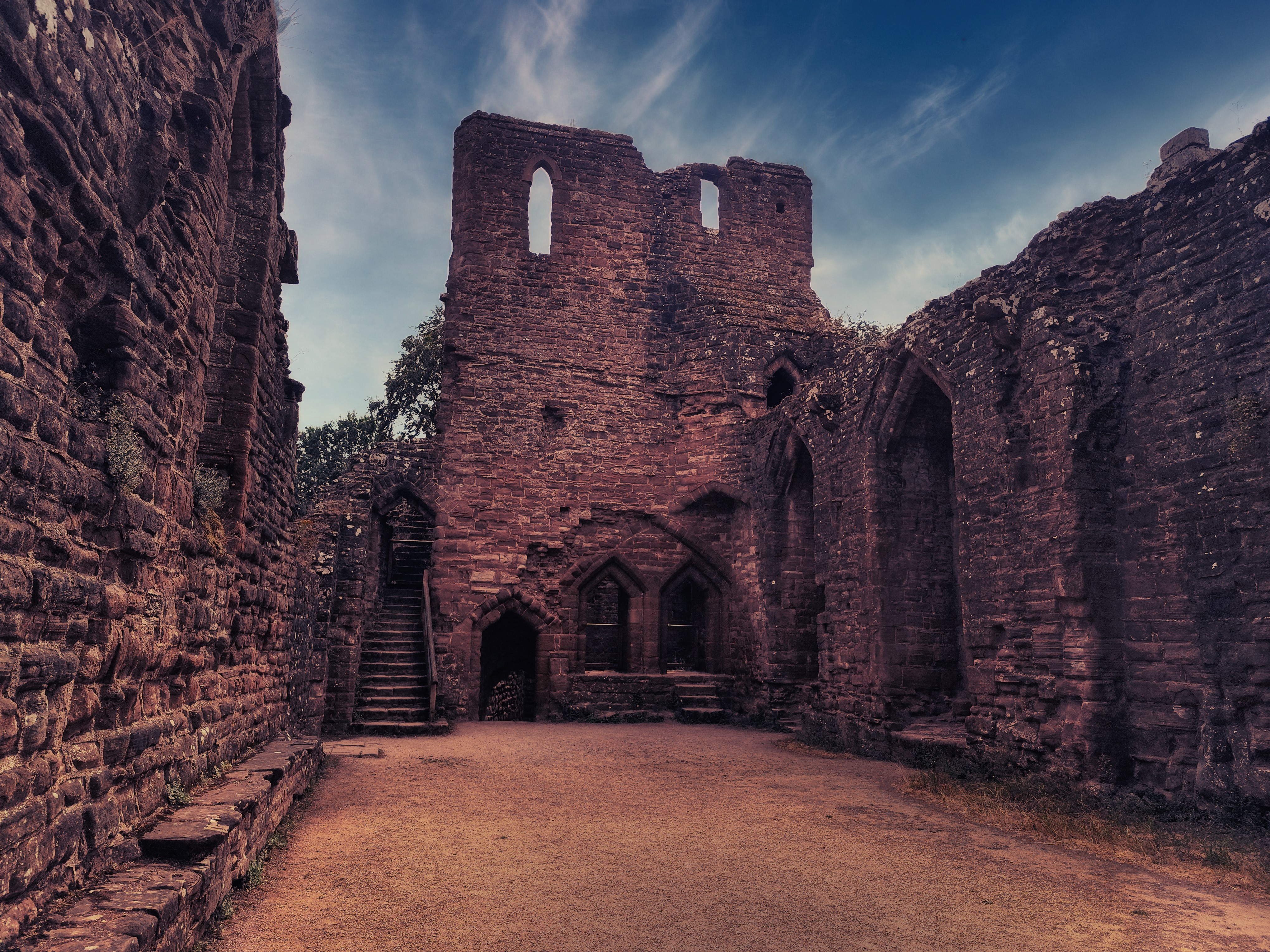
📷Interior Courtyard
| Category | #momentsinfocus |
| Photo taken at | Wales |

@marcoteixeira
Upvoted! Thank you for supporting witness @jswit.
I loved how you highlighted Joan de Valence’s household—especially the roles of the baker, chaplain, and farrier—because it really humanizes the castle beyond its stone walls; did you find any particular anecdote about the household’s daily routines that surprised you? 🌿🏰📚